
Fighting back: Sara Huntley battles Parkinson’s disease in unique way
By Chelsea Retherford | Staff Writer
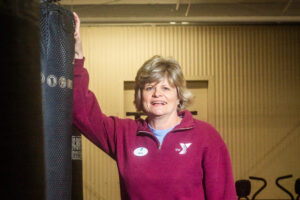
After more than three decades spent troubleshooting computer problems at the University of North Alabama, Sara Huntley traded in her keyboard for boxing gloves.
The longtime information technology (IT) specialist never expected retirement would lead her to the gym floor, or that she’d eventually end up helping people with Parkinson’s disease “fight back” through a program called Rock Steady Boxing at the Shoals YMCA.
“I’m not really a boxer,” Huntley said, laughing. “But we have a boxing program that’s designed for people with Parkinson’s, because boxing training works on everything they need — balance, agility, and strength. There’s proven research showing how it helps offset symptoms and improves their quality of life.”
Rock Steady Boxing, a national nonprofit program founded in 2006, has been changing lives across the country by using non-contact boxing drills and conditioning exercises to help people combat the physical and cognitive challenges of Parkinson’s disease.
The Shoals YMCA launched its Rock Steady chapter in 2018, and Huntley has led the program since 2020.
What began as a volunteer effort quickly became a passion, and a new purpose for Huntley.
Before she was known for punching bags and balance drills, Huntley was a fixture in UNA’s IT Department, where she worked in technical support for 32 years. Her days were filled with network issues, email glitches, and troubleshooting faculty requests — stressful work that required constant focus but offered little room for creativity or connection.
“To help with the stress, I started teaching a lunchtime fitness class for employees at UNA,” she said. “That was my outlet. It was my way to take a break from the tech side.”
Through the university’s Scale Back Alabama wellness program, Huntley met fitness director Glenda Richey, who encouraged her to get certified as a personal trainer.
“Glenda trained me, and she said, ‘You’d be good at this — you should do it,’” Huntley recalled. “She mentored me and helped me study for the exam. I passed my personal training certificate, and I started doing a little personal training here at the Y.”
Huntley soon found herself teaching a 5 a.m. spin class before work. It was an early morning commitment that, surprisingly, stuck. Ten years later, she’s still leading that same group, many of whom have pedaled beside her for the better part of a decade.
“I call them my ‘Almost Family,’” Huntley said with a grin. “We’ve celebrated birthdays, supported each other through sickness, through cancer, through loss. We’ve been through a lot together.”
She’s quick to note that it’s not just exercise, it’s community.
“We’ve had members face serious illnesses, but they always come back. We’re there for each other. If someone misses class, everyone asks, ‘Where were you?’”
That spirit of connection would become central to the next chapter of her life.
When Huntley retired from UNA in 2020, she thought she’d finally have time to relax and maybe travel more. Instead, she found herself drawn back to the YMCA.
The Rock Steady Boxing program had launched two years earlier under instructor Renee Horton, but it had gone dormant during the pandemic. When the YMCA reopened its classes, organizers needed someone to help bring the program back.
“At first, it was just that they needed some help, and I had the time,” Huntley said. “But then I fell in love with it.”
She now leads two Rock Steady classes each week, serving nearly 40 participants. One class is for people who’ve been recently diagnosed with Parkinson’s and are still fairly mobile; the other is for those in more advanced stages of the disease.
“Dividing the classes allows us to target specific exercises for each group,” she said. “When we started this, we only had one class. Then it started growing so much, it was hard to come up with exercises that both groups could do and benefit from.”
Rock Steady participants must have a Parkinson’s diagnosis and a doctor’s approval to participate. Volunteers often assist during classes, helping participants with equipment, balance, or encouragement.
“It’s a social thing, too,” Huntley said. “At first, some of them didn’t want to split into two groups because they didn’t want to lose that connection. But once they saw how much better the classes worked for them, they understood.”
Huntley admits she didn’t know much about boxing when she began.
“I know the basics — jab, cross, hook, uppercut,” she said. “It’s the training behind boxing that’s so beneficial. Boxers work on balance, because when they get hit, they have to catch themselves. They work on agility, being quick on their feet, and they build strength. Those are the same things Parkinson’s affects.”
She explained that Parkinson’s causes muscles to become rigid, making movement difficult. The repetitive, coordinated actions of boxing drills help retrain the body and brain, improving balance, strength, and reaction time.
“Even hitting the bag releases dopamine,” Huntley said. “That’s important because Parkinson’s slows down the brain’s dopamine production.”
The results, she said, are often remarkable.
“It’s just an amazing thing to witness. You see the condition these people are in when they start, and then two or three months with the program, you see them walking better, moving better, and you see them enjoying things, smiling more. It’s incredible.”
Huntley can rattle off countless stories of progress that keep her motivated.
“A couple of things definitely stand out,” she said. “Like this one guy, he came back after Thanksgiving break one year and told me, ‘I am so happy! I was able to climb the ladder to the attic and get my Christmas decorations down.’ He said he’d not done that since he’d been diagnosed. He gave credit to the class.”
Another participant, now in his 80s, texted her this fall from the East Coast as he was in the midst of a month-long hiking trip.
“He said, ‘Thanks to you and the Rock Steady class, I’m able to do this,’” she recalled. “That’s rough terrain! But he’s been fighting back for five years now. He sees the importance of exercise, and you know, to keep moving and staying active. That is very vital to the Parkinson’s population.”
Sometimes, the progress isn’t physical, it’s emotional.
“One little lady came in one day just pounding that bag,” Huntley said, laughing. “I asked, ‘Who are you hitting?’ She said, ‘My husband.’ I told her, ‘Then hit harder!’”
Humor aside, Huntley said the exercise can be cathartic.
“It is a stress relief. They’re fighting the disease, and sometimes you just need to hit something.”
Beyond the physical benefits, Rock Steady Boxing has built a tight-knit community of people who understand each other’s struggles.
“One lady told me she thought she was the only person in her community with Parkinson’s,” Huntley said. “She had stayed home for two years after being diagnosed. When she came here, she looked around and said, ‘Look at all these people — they have the same thing I have.’ That’s what this program does. It brings people together.”
It also brings hope. While Rock Steady can’t cure Parkinson’s, research shows it can slow the disease’s progression and improve mobility and confidence.
“You can see it in their faces,” Huntley said. “It gives them life.”
She incorporates small, functional exercises into her sessions, like buttoning shirts, zipping coats, or even folding laundry to help participants practice daily skills.
“It’s those little things we take for granted that mean so much,” she said.
As Huntley spent more time with her boxers, she noticed another group that needed attention.
“Parkinson’s doesn’t just affect the person diagnosed,” she said. “It affects the spouse or caregiver too. Their whole life changes. They’re lifting, helping with meals, with mobility — things we don’t think about.”
With help from a graduate student at UNA, Huntley helped start a monthly support group for spouses and caregivers of Parkinson’s patients. The group meets once a month at the YMCA and has quickly become a vital resource.
“They share stories and advice, just like our boxers do,” Huntley said. “It’s been a big hit.”
In addition to Rock Steady, Huntley continues to teach her 5 a.m. spin class and offers personal training sessions. Most often, she added, those training sessions are with older adults looking to stay strong and steady.
“I don’t know how this happened, but most of my clients are seniors,” she said. “We work on strength and mobility, and I use a lot of the same balance training I use with the Parkinson’s class. It’s beneficial for everyone as we age.”
Teaching, she said, keeps her accountable too.
“I’ll see balance issues in myself sometimes,” she admitted. “I’ll be demonstrating something, lose my balance, and think, ‘OK, I need to work on that.’ It’s a good reminder.”
Huntley spends hours preparing workouts, researching exercises, and watching instructional videos to keep her sessions fresh. It’s work, she said, but not the kind she used to dread.
“I spent 30-something years helping people with their technology needs,” she said. “But at the end of the day, what did that really do to help someone’s life? With this, I feel like I’m making a difference. This matters.”
She hopes to one day spend more time hiking and kayaking with her husband once he retires, but for now, her time is devoted to her classes and her boxers.
“It consumes more time than I ever imagined,” she said, smiling. “But I wouldn’t trade it. It’s not really a job to me. It’s not really work.”
From 5 a.m. spin sessions to afternoon boxing rounds, Huntley’s days are packed with movement, laughter, and encouragement. And in every class — whether on a stationary bike or in the boxing ring — she’s helping people reclaim a piece of themselves.
“This isn’t just about exercise,” Huntley said. “It’s about living fully. I tell my boxers, ‘Keep moving. Take the trips. Do what you love and do it as long as you can.’”
And every time a glove hits the bag, or a shaky hand manages to tie a shoelace again, it’s proof that her mission to help others fight back is working.