
Shoals Habitat for Humanity: Building hope for 34 years
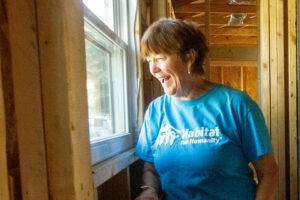
By Chelsea Retherford | Living 50 Plus
When single mom Breanna Turner walked into her new home for the first time this fall, she wasn’t alone. Standing beside her were two women who had been there from the beginning — Nell Eggleston and Jacqueline Broder, volunteers who guided her through every step toward homeownership.
For Eggleston and Broder, who have spent decades building homes and hope through Shoals Habitat for Humanity, moments like that are what keep them coming back year after year.
“It’s a wonderful thing,” Turner said. “They’ve both been so sweet and patient through everything. I was nervous at first, but they broke it all down for me and made it easy to understand. This whole experience has been a blessing.”
Turner, a single mother of two boys, spent much of 2024 putting in her required sweat equity hours into the Habitat build site — both on her own home and others. Her oldest son, 17, and youngest, 10, often joined her, hammers in hands.
“I’m glad they can be here and help some, too,” she said. “I think it teaches them to appreciate it. We came by the day they broke ground, and I just cried in disbelief that it was actually happening.”
For Eggleston and Broder, helping families like Turner’s achieve homeownership has become a defining part of their lives.
Eggleston, now 75, began volunteering in the early 1990s, after her niece became the recipient of Shoals Habitat’s seventh home.
“I saw what an excellent program it was,” she said. “So, I started volunteering and helping out. It’s a wonderful program.”
She worked on her first build — House No. 8 — in east Florence, and she’s been involved ever since. Over the years, she’s seen the program evolve from building one or two houses a year to tackling multiple projects at a time.
“We were the first Habitat affiliate in Alabama,” Eggleston said proudly. “Back in the day, we built everything with volunteers — plumbing, roofing, electrical, everything. We had a group of about a dozen people who would show up every single day, and we’d finish a house in about three months.”
Now serving her second term as board president, Eggleston also serves on the Family Selection Committee and teaches classes for prospective homeowners — classes covering everything from basic finance to home maintenance.
Broder, 71, joined Habitat full time after retiring from TVA in 2013, where she worked as an agricultural engineer for 32 years.
“I retired on a Friday and went to work on a Habitat house that Saturday,” she said with a laugh. “It was a women’s build. They were encouraging women to get involved, and I’ve been here ever since.”
Before retirement, she occasionally helped on Saturday builds, but once she had the time, she jumped in with both feet. Today, she serves as the organization’s volunteer coordinator, organizing work crews and often picking up tools herself to help finish out each project.
Together, Eggleston and Broder have guided dozens of new homeowners through the process of earning and maintaining their homes.
A common misconception, they said, is that Habitat homes are simply given away.
“That’s not how it works,” Broder explained. “The families do buy their homes. We’re the mortgagee, and it’s a zero-percent loan, which makes a big difference for people who can’t qualify for a traditional mortgage.”
Families are selected based on income, debt ratio and need. Once approved, they must complete 200 Sweat Equity Hours — volunteer time that can be earned by working at the Habitat ReStore, attending required homeownership classes, and helping at build sites. Friends and family can also pitch in to help meet the total hours.
“They become part of the process,” Eggleston said. “It’s not just about owning a home, it’s about learning how to care for it, how to budget, and how to understand what it means to be a homeowner.”
Each future homeowner attends 10 required classes before receiving their keys. The first covers financing and sweat equity expectations, while others teach practical skills such as basic electrical safety, budgeting, and home maintenance.
Eggleston often leads the finance and orientation sessions, while Broder teaches landscaping and maintenance. Local professionals also volunteer as guest instructors — attorneys, police officers, electricians, and others — offering their expertise.
“It’s amazing what people learn through this process,” Eggleston said. “I just love it when we present them with their home. It’s such an emotional event. You can see how much it means to them.”
By the time House No. 89 was completed this fall for the Turner family, Shoals Habitat had built nearly 90 homes since its founding in the 1980s.
The organization has seen its share of changes — and challenges — over those decades.
When the COVID-19 pandemic hit in 2020, most of the core volunteers were in their 60s, 70s, and even 80s — the age group most vulnerable to the virus.
“We had to regroup and figure out how we were going to keep building,” Broder said. “We still had the need — even more so — but we couldn’t put people at risk.”
The board made the decision to hire contractors to complete builds during that time, which increased costs but kept the program active.
“To remain in good standing with Habitat for Humanity International, we have to build at least one house a year,” Broder said. “During COVID, we managed to do that. It wasn’t easy, but we did it.”
Once restrictions eased, volunteers began returning to the worksites. Broder was among the first to push for bringing back more hands-on involvement to help reduce costs.
“The first task we gave back to volunteers was vinyl siding,” she said. “It’s outside work and a great place to start for people who may not have construction experience. From there, we’ve added painting, landscaping, and finishing touches like blinds and towel bars.”
She often works side by side with new homeowners on those final steps.
“I bring my tools, but they get to do it themselves,” she said. “It’s a neat learning experience for them. They get to see what goes into building their house.”
The past two years have been among the busiest in Shoals Habitat’s history. Thanks to a $500,000 ARPA grant written by Executive Director Lisa Parker, the affiliate has completed five new homes in just two years — an extraordinary pace for a program that once averaged one or two builds annually.
“Seeing five houses go up in two years, it’s just unbelievable,” Eggleston said. “We finished House 84 in 2024, then 85, 86, 87, and 88. House 89 is Breanna’s, and we’ve already started House 90.”
Volunteers from across the Quad Cities — Florence, Sheffield, Tuscumbia, and Muscle Shoals — have contributed, along with special crews from TVA in Knoxville, Tennessee, and Chattanooga, Tennessee, who recently helped with repairs on older homes.
“Everyone works together to make this happen,” Eggleston said. “Even the people who work at the Habitat ReStore are helping make homes possible. Every donation goes directly to construction. There’s no overhead. That’s important for people to know.”
After decades of service, both women say their motivation remains the same — helping others.
“I just think it’s really important to give back to your community,” Broder said. “When you attend one of these dedications, it’s so touching and emotional. It makes it all worth it.”
For Eggleston, the work is deeply spiritual.
“You’re giving of your time. You’re serving, and that’s what God requires of all of us,” she said. “You help others along the way, because you never know when you’re going to need help.”
As Shoals Habitat looks ahead to its 90th home and beyond, both women hope more people will step up — whether by volunteering, donating, or spreading the word about the organization’s mission.
“I would say donations are our biggest need right now,” Eggleston said. “The grant ends this year, but the work doesn’t stop. We still need people’s support to keep building.”
For Turner, that support has already changed everything. She plans to continue volunteering on future builds even after moving into her home.
“I’m going to stick with it,” she said. “It’s been hard sometimes — working full time and raising kids — but Jacqueline worked with me and helped me get my hours in. I’m just so grateful for all of it.”
Her home, completed just in time for the holidays, stands as the newest chapter in a story Eggleston and Broder have been helping write for more than three decades — a story built not just from wood and nails, but from service, compassion, and faith.