
Born to be a nurse: Her lessons came from experiences lived.
By Chelsea Retherford | Living 50 Plus
Long before Sabrina Clark became a nurse — a profession which saw her caring for mothers and babies in the maternity ward of Eliza Coffee Memorial Hospital in Florence for over three decades — another nurse worked tirelessly one night to save Clark’s mother’s life in the very same hospital.
That night, what should have been a routine delivery turned critical. Clark’s mother, Neva Bretherick, began hemorrhaging severely after childbirth. Her doctors feared she would not survive.
“She was losing blood as fast as they were giving it to her,” Clark explained.
The nurse anesthetist on duty was Jean McCabe — a woman whose calm expertise and deep compassion would leave an imprint which lasted for generations, even though she never knew it.
Bretherick lived, and decades later the baby would become a nurse herself — one who would eventually cross paths with McCabe’s daughter in a moment which felt less like coincidence and more like fate.
Clark grew up hearing the story of her birth, even though her mother remembered little of the ordeal itself.
“I didn’t know anything, but Miss McCabe said I was a lucky bird,” Bretherick said, recalling what she could of the hazy, yet traumatic experience.
“You know, even if I did know, it was all Greek to me. Nothing was ever really explained to me, but when Sabrina became a nurse, she put things together, you know. She realized (hemorrhaging) is probably what it was.”
What Bretherick did remember was the nurse who stayed with her.
“She wasn’t just a nurse,” Bretherick said. “She was a friend.”
About a month after Clark was born, Bretherick ran into McCabe again at the hospital.
“She remembered me,” Bretherick said. “And what a hug did I get. She was the sweetest lady you could ever meet.”
They didn’t stay in close contact, but when their paths crossed over the years, McCabe never forgot her. Although Clark had never met her mother’s hero, the story stayed with her as well.
Still, it’s a story which might have ended if not for a chance meeting decades later at the University of North Alabama.
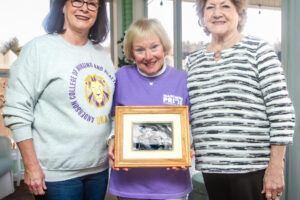
Ahead of the university’s homecoming celebrations for 2025, Clark was being honored with the Lifetime Achievement Award for more than 40 years of excellence in nursing and mentorship. Little did she know, Jean McCabe’s daughter, Briget McCabe, was receiving the Friend of the University Award for her philanthropic support of UNA programs, including the Marching Pride, College of Nursing, and Engineering Department.
The morning of the awards ceremony, award recipients and their families gathered for a tour of UNA’s new football stadium. The group was split into smaller clusters.
“If we hadn’t gone on that tour, we probably would not have met,” Briget McCabe said. “It was a big dinner, and there were so many people there that night. You had your own table, and I didn’t really know anybody other than a few of the UNA faculty.”
As introductions were made, Clark mentioned her career in nursing.
“When I heard that, I really wanted to talk to her, you know because of Mama,” McCabe said.
Then Clark asked the question, “Do you know Jean McCabe?”
“Well,” Briget replied, “that was my mother.”
Clark immediately told her the story involving her own mother.
“I was just blown away,” Briget said. “But at the same time, I wasn’t surprised. That was just the type of person my mother was.”
The late Jean McCabe’s life was defined by service and independence.
“She was ahead of her time,” said Briget, smiling as she shared her own stories about her mother.
Nurse McCabe’s career started with the U.S. Army. She had worked in the American Hospital in Paris, France, and trained alongside leading physicians. As an Army nurse she had been stationed in Alaska, where she met Briget’s father.
“She found out she was expecting me, and he wanted her to have an abortion,” Briget said. “Mama said ‘no,’ and she raised me by herself.”
Growing up, Briget often stayed at the nurses’ home — a communal residence where unmarried nurses lived and supported one another.
“It was a beautiful home,” Briget said. “You know, it was tough, but she made it work. On nights when she would be working late hours, I’d spend the night with some of the other nurses, and I felt so big.”
Jean McCabe died in 2000 after developing pneumonia and suffering a stroke. Even in her final months, her presence left an impression.
“All her nurses just loved her,” Briget said. “One of her nurses actually shared my mother’s birthday, Jan. 8. She was not my mother’s nurse the night she died, but she had gone in to check on her, and she told me later that she was with her when she died.”
Saddened she couldn’t be at her mother’s side at the moment, Briget said she finds comfort knowing her mother was surrounded by loving people in her last hour.
“I was supposed to go to work that day and come back,” Briget recalled. “They called me at 4:30 that morning to tell me the news. When I got to the hospital, the lady in her room said, ‘Are you back from your trip already?’ I said, ‘No, I just came to be with Mama because she’s gone home to God.’ The lady said to me, ‘I’ve been praying for your mother. Now I can pray to your mother.’”
For Briget, her mother’s death marked the end of one chapter, but not the end of her legacy. Keeping the legacy alive is one motivation behind Briget’s support for the university near her home in Florence, where she spends a few months out of the year.
Her second residence is in Lynnfield, Massachusetts.
“Marriage took me north in 1970, but I still love Massachusetts. It’s a beautiful state,” Briget explained. “When that marriage ended, I had also been laid off from my banking job. I had never had any children, so I thought, ‘I don’t know what I’m going to do for my next career, but it’s going to be fun and it’s going to involve travel.’”
Those dreams were manifested in a 30-year career with Delta Airlines. While working as a flight attendant, she met her second husband, Ed, who she had met jogging near her home in Massachusetts.
Briget retired as a flight attendant in 2020, choosing to step away during the COVID pandemic to care for her husband as his health declined. It was this turn of events which brought the couple back to Briget’s former hometown.
“Ed and I had always enjoyed coming to Florence whenever we could,” she said. “He was endeared by our gracious Southern hospitality.”
On those previous trips to Florence, the couple kept up their shared passion for jogging on the UNA track, where they often heard the university band practicing nearby.
“As soon as we came to Florence, Ed and I would head straight over to the track,” she said. “Even though neither of us attended UNA, we loved listening to the band, getting to know Lloyd Jones, his dad, and many of the students.”
She didn’t know it then, but those moments on the jogging track would be the start of her philanthropic journey.
After Ed’s passing about three and a half years ago — just a week before renovations were set to begin on the home they planned to retire in — Briget decided to honor her mother and her late husband by giving back to the university she and Ed had grown so fond of.
“Of course, my support for the College of Nursing is in loving memory of my mother,” she said. “Ed was a retired electrical engineer at Honeywell, so it just felt right to support the Engineering Department as well.”
While all three of those departments she has chosen to support are dear to Briget’s heart, she said she’s especially proud to give to the Anderson College of Nursing at UNA, further fostering a connection she had to Sabrina Clark before either of the two women realized it.
For Clark, nursing was a given. She feels certain she would have found the calling even if she hadn’t grown up hearing the story about how Jean McCabe had saved her mother’s life the night she was born.
“I’ve had people ask me whether that inspired me, and maybe it did some,” Clark said. “I’ve always wanted to be a nurse. Even from my earliest memories. I was about two years old when I got this doll called Nancy Nurse. I knew I was going to be a nurse just like that doll.”
“And she did,” Clark’s mother said proudly. “She became a really good one. I’ve learned so much from her.”
Clark graduated from UNA in 1985 and went on to build a career that has spanned more than four decades — first with ECM, the same hospital where she’d been born, and then at North Alabama Medical Center.
For 38 years, Clark worked in obstetrics, caring for mothers during some of the most vulnerable moments of their lives. More recently, she transitioned to a PRN role [“pro re nata,” or “as the need arises”] in outpatient care, a change which allowed her to spend more time with her grandchildren.
Still, even after stepping back from full-time hospital work, Clark never stepped away from teaching. Since 1997, she has served as an adjunct clinical supervisor at UNA, helping guide nursing students through their earliest experiences in patient care.
“As I teach student nurses, this is what I try to instill in them,” she said. “Your care, your expressions, the way you talk to people — they’ll never forget it.”
It’s a lesson passed down through experiences lived, not textbooks.
While Clark doesn’t claim the story of her birth as career-defining, she doesn’t outright dismiss its influence either.
“My motto when I first started was that I treated my patients like it was my own daughter in that bed. When they’re in my care, I am totally advocating for my patients,” she said. “I think that’s the trait of a nurse. It’s just in you. Maybe it’s something you were born with, but I think your practice and your profession make you that way.”
It’s a philosophy Bretherick immediately recognized.
“The same way Briget’s mother treated me,” she said. “She treated me like a daughter.”
For Briget, seeing her mother’s legacy reflected back through another family has been deeply affirming.
“To see Mama’s impact live and in person,” she said, “it’s overwhelming in the best way.”